Heat Safety: Heat Index & WBGT
- 4.7
- Rating
- 10.00K
- Installs
- Free
- Price

 Analysis by App-foxy
Heat Safety: Heat Index & WBGT is the kind of weather app I would open before sending anyone outside on a hot day, rather than after the temperature has already become uncomfortable. Its focus is narrow but useful: it brings heat index, wet bulb temperature, and outdoor-work forecasts into one place. That makes it less of a general weather companion and more of a decision aid for people who need to judge whether outdoor activity is sensible.
I reviewed it as an Android weather app from Qvyshift LLC, and my main impression is that it is built around a practical question: “What will the heat feel like, and how risky could outdoor work become?” The app is free to install, rated for Everyone, and has earned a 4.7 average from over 300 ratings. Those figures suggest a small but positive user base rather than a mass-market weather service, which fits its specialized purpose.
How I would decide whether this app belongs on my phone
The first thing I would consider is whether ordinary temperature forecasts are enough for me. If I only want to know whether to carry an umbrella, check a weekend forecast, or see the current temperature, a standard weather app is probably more convenient. Those apps usually cover many everyday details in a familiar format. Heat Safety: Heat Index & WBGT earns its place when the heat itself is the main concern.
You May Also Like

 Pandora - Music & Podcasts
Pandora’s Music Is Easy to Start, but Harder to Recover
Pandora’s strength is its low-effort path from a seed to a station. Its weak spot is how much confidence it asks you to place in connection, setup, and quiet recovery.

 AccuWeather: Weather Radar
AccuWeather Review: A Quick, Clear Forecast for Everyday Decisions
For everyday plans, the best forecast is the one you can understand quickly. AccuWeather makes rain timing, radar, and local conditions easy to act on, with a few trade-offs.

 Hill Climb Racing
Why Hill Climb Racing Still Turns Crashes Into One More Run
A tiny car, a bumpy hill and one more upgrade: Hill Climb Racing keeps resurfacing because its simple chaos makes every near-miss feel personal.

 AliExpress - Shopping App
AliExpress Makes Global Shopping Feel Personal, but Shoppers Bear the Risk
AliExpress turns a global marketplace into a pocket-sized discovery engine. Its reach is useful, its shopping loop compelling, and its trade-offs easy to miss.

 Lords Mobile: Kingdom Wars
Lords Mobile Is a Kingdom-Building Routine, Not a Quick Match
A case-by-case verdict on the building, battles, device demands, and social commitments that make Lords Mobile rewarding for some players and exhausting for others.

 PDF Scanner app - TapScanner
TapScanner Makes Paperwork Easier to Capture, Check, and Share
TapScanner makes scanning with a phone feel less like a rescue operation and more like a dependable step in getting work done. Its capture tools are useful, though not flawless.
More From Our News Desk
View All News


Heat index is useful because air temperature alone does not describe how oppressive conditions may feel when humidity is high. Wet bulb temperature adds another perspective, especially for people thinking about the body’s ability to cool itself. I would not treat either number as a personal medical verdict, but I would use them as warning signals that deserve more attention than a simple temperature reading.
The app is especially relevant to outdoor workers, supervisors, coaches, grounds crews, event organizers, gardeners, delivery staff, and anyone planning sustained physical activity in warm weather. It can also help a household make a more careful plan for yard work or a long day outside. The important distinction is that it supports preparation; it does not replace judgment, breaks, shade, hydration, or professional safety procedures.
Before installing it, I would also ask whether I need a full weather dashboard. This app’s identity is its heat-safety focus. Someone who wants radar, detailed precipitation maps, severe-weather alerts, air-quality readings, and a broad collection of daily weather tools may prefer a conventional forecast app. Someone who already has those features but lacks a clear way to think about heat exposure may find this a useful companion instead of a replacement.
The numbers matter most when they change a plan
A common mistake with heat information is checking it once and then assuming the whole day will feel the same. I would use this app at several decision points: before work begins, around the expected hottest period, and again before extending an activity. A forecast that looks manageable early in the morning can become a very different planning problem later.
My practical approach would be to compare the forecast with the task itself. Light activity in shade is not the same as lifting materials on asphalt under direct sun. A heat reading should make me ask how long people will be outside, how much clothing or protective equipment they need, whether shade is available, and how easily they can take breaks. The app is most valuable when it prompts those questions instead of being treated as a single green-or-red answer.
For a supervisor, the useful workflow is to check the forecast before assigning outdoor work, then build a plan around the more demanding part of the day. That could mean moving strenuous tasks earlier, shortening continuous work periods, or arranging more frequent recovery time. The app does not need to manage those policies to be helpful; its role is to make heat conditions visible while the plan is still flexible.
A realistic morning use case
Imagine I am helping with a landscaping job on a humid summer morning. The ordinary temperature forecast might not look alarming when I leave home. I would open Heat Safety: Heat Index & WBGT, examine the heat-focused forecast, and compare the expected conditions with the work: carrying equipment, bending repeatedly, walking across exposed ground, and wearing clothing that may limit cooling.
If the conditions become more concerning later, I would schedule the heavier work first, keep water and shaded recovery nearby, and avoid assuming that a short early period means the whole shift will be comfortable. I would check again before adding an extra task. That second check is a small habit, but it is one of the more useful ways to turn a forecast into a safer decision.
For a youth sports coach, I would use the same principle differently. The question is not simply whether practice can happen, but whether the session should be shorter, less intense, or organized with more recovery. Children may not recognize or communicate heat strain quickly, so the app’s information should lead to a conservative plan rather than a challenge to push through.
Where the focused design wins
The strongest part of this app is its specialization. Instead of burying heat-related information among general conditions, it puts heat index, wet bulb temperature, and outdoor-work forecasting at the center. Its real advantage is turning heat from a background weather detail into the main planning question. That focus can be more useful than a crowded weather screen when the user’s priority is physical safety outdoors.
I also like the way the app encourages a more nuanced view of heat. Temperature is easy to understand, but it can be misleading when humidity, exertion, clothing, and exposure are involved. Having both heat index and wet bulb temperature available gives me more context than relying on the number shown by a basic weather app. I still need to interpret the information responsibly, but I am starting with better inputs.
Another strength is its fit for repeated routines. A person responsible for outdoor work may not want to research heat conditions from scratch every morning. A dedicated tool can become part of a simple checklist: open the app, review the forecast, look at the planned work, and adjust the schedule. That is a more realistic use than expecting workers to remember a technical threshold or make a decision from air temperature alone.
The app’s free entry point also lowers the barrier to trying it. I can install it without committing to a subscription, explore whether its heat-focused approach fits my routine, and decide whether optional purchases are worthwhile. The in-app purchase range is from $0.99 to $5.99 per item, so I would check what each purchase adds before paying. For occasional personal use, the free starting point may be enough; regular professional use deserves a closer look at the available options.
Why the developer’s narrow choice is useful
Qvyshift LLC has chosen a subject that many general weather apps treat as one tile among many. That makes this app easier to evaluate: I do not need to ask whether it replaces every weather tool. I only need to ask whether it helps me make better heat-related decisions. In my experience, specialized apps are often strongest when the user has a recurring problem rather than a general curiosity.
The current version is 3.3.1, and the app runs on Android 8.0 or later. That makes it accessible to people using older Android devices, which can matter for shared work phones or inexpensive phones kept for outdoor jobs. I would still make sure the device is comfortable to use in bright conditions and that the person checking it can do so without treating the screen as a substitute for observing coworkers or participants.
The Everyone age rating is also appropriate for the subject. Heat safety information can be relevant to a family, a school activity, or a workplace. That does not mean every user will interpret the readings equally well, though. I would explain the numbers to younger users and make sure an adult remains responsible for decisions involving children or organized activity.
Three habits that make the app more useful
First, I would check trends rather than isolated readings. A single comfortable-looking moment does not tell me how demanding the next several hours may be. Looking ahead helps me plan the difficult work before conditions peak, instead of reacting after people are already tired.
Second, I would pair the app with a task inventory. Before opening it, I would list the work that requires the most effort, the work that can be moved indoors, and the work that can be postponed. Then the forecast has a direct purpose. This is more effective than staring at heat values without deciding what they mean for the schedule.
Third, I would use wet bulb information as a prompt to consider recovery conditions, not merely as another score to compare. If the environment makes cooling harder, shade and rest become more important. A shaded break area that is too far away, poorly ventilated, or unavailable during the busiest period may not provide the protection I assumed it would.
What may slow me down
The same specialization that makes the app valuable can make it feel limited. If I want a broad view of rain timing, wind, radar, or other everyday weather details, I may have to switch to another app. That is not necessarily a flaw, but it creates a two-app workflow for people who want both general forecasting and heat-safety analysis.
There is also a learning curve around the terminology. Heat index is familiar to many people, but wet bulb temperature and WBGT-related thinking may require a little explanation. I would not hand the app to a new worker and assume the displayed values speak for themselves. A short workplace briefing or personal review of what the readings mean would make the information safer to use.
Another limitation is the risk of false precision. A precise-looking forecast can tempt users to believe that it has captured every relevant factor. In reality, local shade, sun exposure, clothing, workload, acclimatization, health, and access to water can change the situation. I would use the app to support a conservative plan, never to justify continuing an activity that already feels unsafe.
Where the usual alternatives may fit better
A general weather app is the better choice for someone who wants one place for a wide range of daily information. If my main needs are commuting, rain timing, weekend planning, or checking conditions across several locations, a mainstream weather service may be faster and more familiar. Heat Safety: Heat Index & WBGT makes more sense beside that kind of app when heat exposure is an important recurring concern.
A workplace safety process may also be a better primary solution for a company. Formal procedures can define responsibilities, break schedules, training, emergency responses, and communication. This app can inform that process, but it should not be treated as a complete occupational safety system. For a business, I would want the app to support an existing plan rather than become the only plan.
Someone with medical concerns should be especially careful about using any weather reading as a personal clearance. The app can help identify demanding conditions, but individual tolerance varies widely. If I were managing a condition affected by heat, I would follow medical advice and use the app only as general environmental context.
I would also skip it if I rarely spends time outdoors in hot or humid conditions and already feel well served by a regular weather app. Installing a specialized tool is worthwhile when its information changes what I do. If it would only confirm that I should stay indoors occasionally, the extra focus may not justify another app on the phone.
The trade-off of adding it to an existing weather setup
The cost of switching is not just financial. It is also the time needed to build a new checking habit and learn how to interpret heat-focused information. Because the app is free to install, the monetary risk is low, but the practical value depends on whether I will actually open it before outdoor work. A rarely opened safety app is less useful than a simple routine that people follow consistently.
I would introduce it gradually: use it for a week of outdoor plans, compare its heat-focused view with what I experience, and note which readings lead to schedule changes. I would not try to replace every weather tool immediately. This trial makes it easier to see whether the app adds meaningful context or merely duplicates information I already receive elsewhere.
The optional purchases deserve the same practical test. I would not buy an item simply because the app is specialized. I would first identify a recurring limitation in my routine, then decide whether the relevant purchase solves it. For a casual user, paying may be unnecessary. For someone checking conditions as part of regular outdoor coordination, a modest purchase could be reasonable if it improves the workflow.
Who should install it now
I recommend Heat Safety: Heat Index & WBGT to people whose plans depend on outdoor heat: supervisors, coaches, workers, volunteers, caregivers, and active households. It is particularly suitable when “the temperature” is too simple a description of the conditions. The app gives those users a focused place to think about heat exposure before deciding how long and how hard to work.
I would recommend it less strongly to someone seeking a complete replacement for a general weather app. It is also not the right tool for making medical judgments, setting a company’s entire safety policy, or guaranteeing that an outdoor activity is safe. Its value is greatest when a responsible person combines the forecast with real-world observation and sensible precautions.
After using it, my conclusion is favorable because the app knows what it is trying to solve. It does not need to be the most comprehensive weather product to be worthwhile. By concentrating on heat index, wet bulb temperature, and outdoor-work forecasts, it gives a specific audience information that is easy to overlook in ordinary weather apps.
For me, the deciding question is simple: will heat conditions change the way I schedule, supervise, or participate in outdoor work? If the answer is yes, I would install it and make it part of my pre-activity routine. If the answer is no, a general weather app may be enough. Either way, the best use of this app is not reading a number in isolation, but using that number to make a safer, more realistic plan.
FAQs for Heat Safety: Heat Index & WBGT
01What is Heat Safety: Heat Index & WBGT used for?
Heat Safety: Heat Index & WBGT is designed to help users understand how hot outdoor conditions may feel and how much heat stress the body could experience. It combines weather information with heat-related measurements, including the Heat Index and Wet Bulb Globe Temperature (WBGT), to provide practical guidance for planning outdoor activities, exercise, work, or sports in hot environments.
02What is the difference between the Heat Index and WBGT in the app?
The Heat Index estimates how hot the air feels by combining temperature and humidity, making it useful for general outdoor comfort and heat-risk awareness. WBGT is a more specialized measurement that can also account for factors such as sunlight, wind, and radiant heat. It is particularly relevant for athletes, outdoor workers, and anyone performing strenuous activity in direct heat.
03Does Heat Safety: Heat Index & WBGT provide medical advice or guarantee safety?
No. The app should be treated as an awareness and planning tool rather than a replacement for medical advice, official weather alerts, or workplace safety procedures. Heat risk can vary depending on age, health conditions, medications, clothing, hydration, acclimatization, and physical effort. Always take symptoms seriously and seek medical help when necessary.
04Does the app require location access or an internet connection?
Depending on the features and version available on your device, Heat Safety: Heat Index & WBGT may use your location to provide conditions for the area around you. Internet access may also be needed to retrieve current weather data or update forecasts. Users who prefer not to share their location can usually enter or select a location manually, although some convenience features may be limited.
05Who can benefit most from using Heat Safety: Heat Index & WBGT?
The app can be useful for runners, cyclists, hikers, coaches, parents, outdoor workers, event organizers, and anyone planning physical activity during hot weather. It helps users recognize when conditions may require more breaks, reduced intensity, extra hydration, shade, or rescheduling. It is especially valuable for comparing ordinary temperature readings with the broader effects of humidity and radiant heat.
Pros
- Combines heat index and WBGT readings for a broader safety overview.
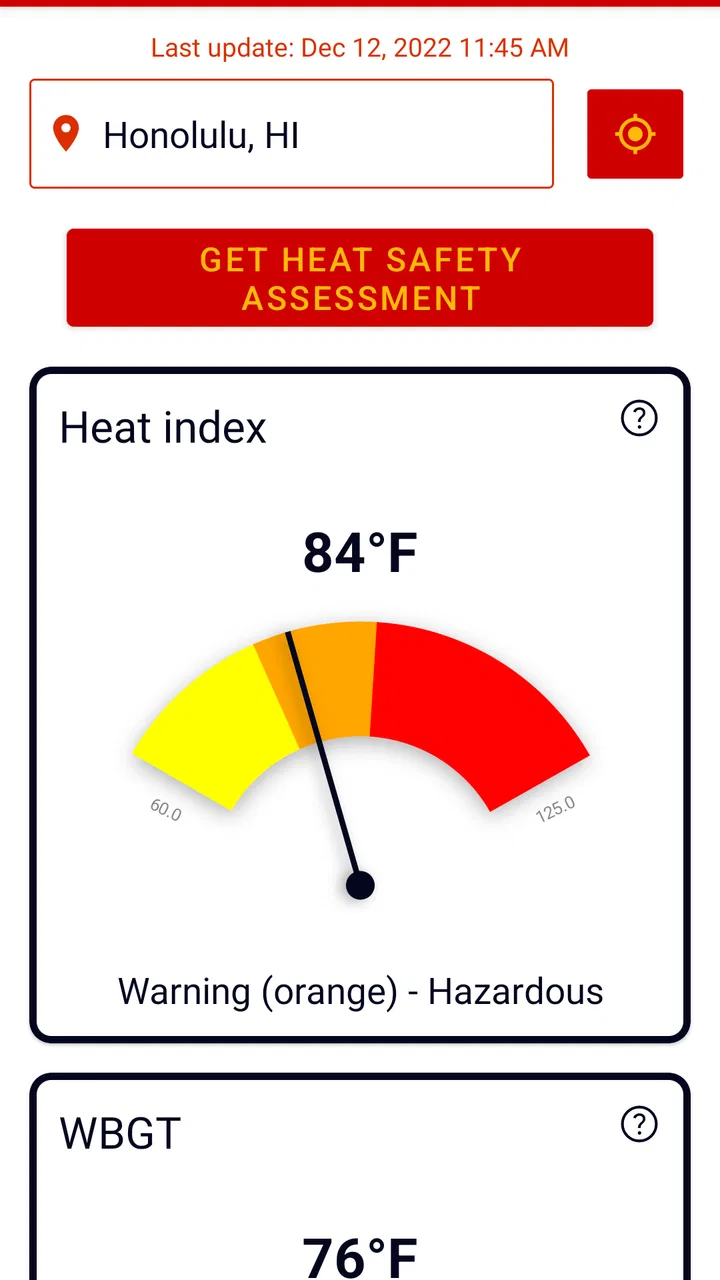
- Clear color-coded risk levels make dangerous conditions easy to spot.
- Useful for athletes
- outdoor workers
- hikers
- and event organizers.
- Can support planning breaks
- hydration
- and reduced outdoor activity.
- Provides practical heat-risk information in a focused
- simple interface.
Cons
- Accuracy depends on reliable weather data and correctly configured location settings.
- WBGT readings may be less useful without local sun
- wind
- and humidity data.
- Risk estimates cannot replace medical advice or workplace safety procedures.
- Frequent location checks or updates may increase battery and data usage.
- Some users may find the technical WBGT information difficult to interpret.

Heat Safety: Heat Index & WBGT
Gallery